
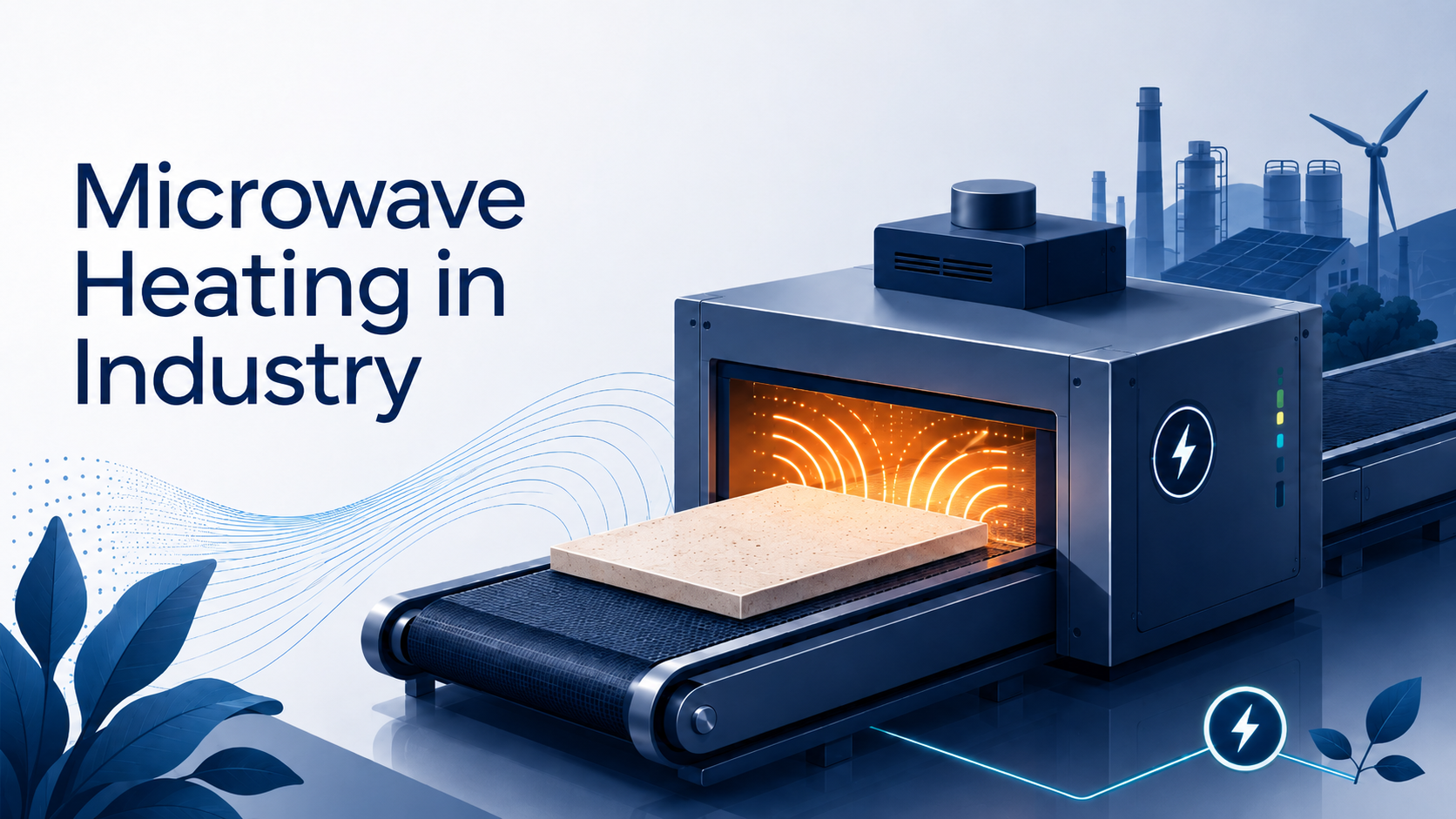
Industrial heating is essential for many products we use every day, from ceramic tiles and cement-based materials to processed biomass and industrial minerals. Most traditional heating systems heat materials from the outside. Microwave heating works differently: it can deliver energy directly into materials that are able to absorb electromagnetic waves.
This makes microwave heating an interesting technology for industries looking for more efficient, flexible and electrified processes. The FLEXHYON project explores this potential as part of a broader approach combining microwaves, heat pumps and ultrasound for selected industrial applications.
From Conventional Heating to Microwave Heating
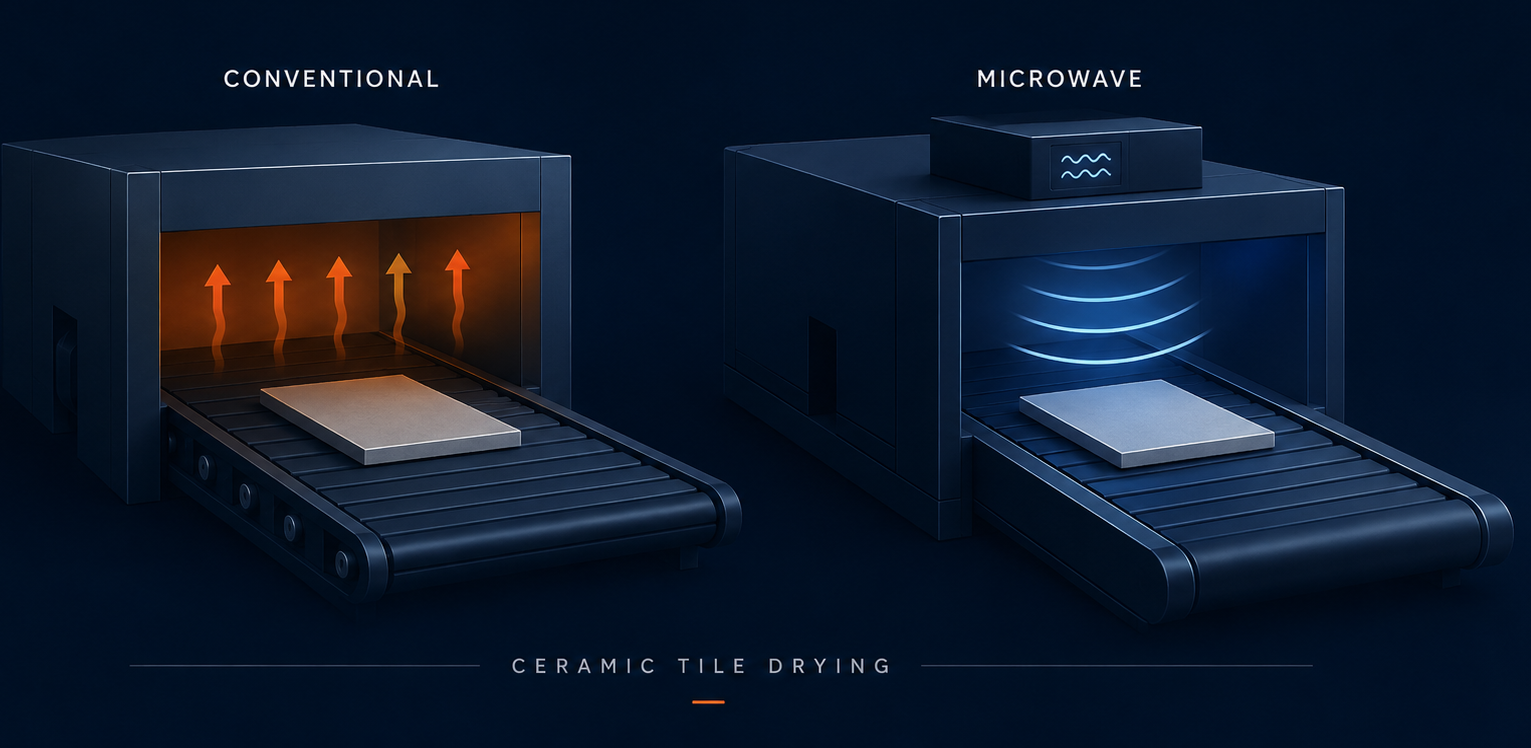
Conventional heating usually starts outside the material.
A burner, hot air flow, heated wall or furnace transfers heat to the surface of the target material. Heat then moves from the outside toward the inside. This approach is widely used and reliable, but it can also involve energy losses.
Part of the energy may heat the surrounding air, the equipment or the furnace walls instead of only the material being processed. In some cases, this can make heating slower, less targeted and more energy intensive.
Microwave heating works in another way. If a material can absorb microwaves, energy can be delivered directly into the material. This can create what is often described as volumetric heating, meaning that heat is generated within the material itself, not only at the surface.
In industry, the question is not only whether microwaves can heat a material. The key question is how safely, uniformly and efficiently they can do so.
This depends strongly on the material’s dielectric properties. In simple terms, this means how the material responds to the microwave field.
Why Material Behaviour Matters
One important lesson from microwave research is that the material is not a passive actor in the heating process.
Previous research co-authored by FLEXHYON researchers Beatriz García-Baños from Universitat Politecnica de Valencia, José M. Català-Civera from Universitat Politecnica de Valencia and Ángel M. López-Buendía from INNCEINNMAT SL investigated iron- and zinc-bearing products during high-temperature microwave heating. The study monitored dielectric properties during heating and showed that factors such as material composition, carbon content and density can influence microwave penetration and heating behaviour.
For industry, this is an important message. Microwave heating cannot simply be copied from one material to another. Each material and each production step require careful testing, design and process control.
This fits well with FLEXHYON’s approach, which focuses on selected industrial processes and adapts advanced heating technologies to real process conditions.
Microwave heating is not only a different way to supply energy. It can also help researchers better understand how materials transform during heating.
This topic was explored in another study co-authored by FLEXHYON researchers Ángel M. López-Buendía, Beatriz García-Baños, Mar Urquiola and José M. Català-Civera. The study investigated gypsum-anhydrite transformations under microwave heating using in situ dielectric analysis and Raman spectroscopy. The authors reported a transformation sequence and identified a previously unreported intermediate phase with a gamma-anhydrite structure.
For a non-specialist reader, the key message is simple: when researchers monitor materials during microwave heating, they can better understand what happens inside the process. This knowledge is important for developing safer, more precise and more reliable industrial applications.
Microwave Heating in Ceramic Applications
Microwave technology has also been explored in ceramic-related processes.
In another study co-authored by FLEXHYON researchers Beatriz García-Baños, José M. Català-Civera, Ángel M. López-Buendía and Luis Guaita from KERABEN GRUPO SA, microwave energy was tested for ceramic frit production at pre-industrial scale. The researchers compared microwave-assisted glass melting with a conventional process and reported that the resulting glazes showed similar properties.
This does not mean that microwaves can replace conventional heating everywhere. But it shows that microwave-assisted processing can be technically feasible for selected ceramic applications when the process is properly designed.
A more recent contribution from FLEXHYON partners was presented at the AMPERE 2025 Conference. In their published abstract, Beatriz García-Baños, Ángel M. López-Buendía, Mar Urquiola, Eduardo Brau and José M. Català-Civera discussed preliminary work on a microwave-based approach for drying freshly pressed ceramic tiles.
This is relevant because drying is an important step in ceramic tile manufacturing. Freshly pressed tiles still contain moisture, which must be removed before glazing and decoration. Today, this is usually done with conventional gas-based dryers using hot air convection.
The FLEXHYON-related work presented at AMPERE 2025 focuses on a rapid but controlled microwave drying method. The aim is to remove moisture while reducing the risk of local overheating, excessive internal vapour pressure, cracks or structural damage. The study used real-time surface temperature monitoring and infrared analysis to better understand temperature distribution during the process.
This is especially relevant for FLEXHYON, as one of the project’s target applications is ultra-fast drying of compact materials in the ceramics sector.
Potential Benefits and Challenges
Microwave heating may offer several potential advantages.
Because energy can be delivered more directly into suitable materials, less heat may be wasted. Microwave systems can also respond quickly, which may support more flexible production.
In some applications, microwave processing may contribute to shorter processing times and potential energy savings. However, these benefits are not automatic. They depend on the material, the system design, the operating conditions and the quality of process control.
Microwave heating also brings challenges. Not all materials absorb microwaves in the same way. Some may heat quickly, while others may need process adjustments or hybrid solutions. Uneven heating can occur if the system is not carefully designed. Industrial microwave equipment also requires accurate monitoring and control.
These challenges are exactly why research and demonstration are necessary. Before a new heating technology can be widely adopted, it must be tested under realistic industrial conditions.
How FLEXHYON Is Exploring Electrified Heating
FLEXHYON develops flexible, fully electrified heating systems for sustainable process intensification. The project combines microwave technology, heat pumps and ultrasound to address three specific industrial processes:
- ultra-fast drying of compact materials,
- drying of granular materials,
- distillation and extraction of ground materials.
These processes are relevant for sectors such as ceramics, feed production and biomass treatment. FLEXHYON will build and demonstrate three optimized prototypes in industrial environments.
The project will also evaluate the quality and economic impact of its developments using life cycle assessment and life cycle costing. Environmental and technical performance, health protection and safety are also part of the validation approach.
At the current stage, FLEXHYON is developing and testing the knowledge, system designs and process conditions needed before wider industrial demonstration. This means that the project is moving from scientific and technical understanding toward practical solutions for real industrial environments.
Supporting Cleaner Industrial Heat
Microwave heating is not a magic solution for every industrial process. Its value depends on science, engineering and careful adaptation to the material.
However, previous research and recent FLEXHYON contributions presented at AMPERE 2025 show why this technology deserves attention. It offers a different way of thinking about industrial heat: more direct, more flexible and potentially more efficient.
As Europe moves towards cleaner industry, technologies such as microwave-assisted heating can help open new pathways for electrified production. FLEXHYON is contributing to this transition by testing how these solutions can work in real industrial applications.
Follow FLEXHYON to learn more about sustainable industrial heating, project progress and upcoming results.
References
- García-Baños, B., Català-Civera, J.M., López-Buendía, A.M. et al. (2020). High Temperature Dielectric Properties of Iron- and Zinc-Bearing Products during Carbothermic Reduction by Microwave Heating. Metals, 10(5), 693.
- López-Buendía, A.M., García-Baños, B., Urquiola, M., Català-Civera, J.M. et al. (2020). Evidence of a new phase in gypsum-anhydrite transformations under microwave heating by in situ dielectric analysis and Raman spectroscopy. Physical Chemistry Chemical Physics.
- Reinosa, J.J., García-Baños, B., Català-Civera, J.M., López-Buendía, A.M., Guaita, L. et al. (2019). Feasible glass-melting process assisted by microwaves.
- García-Baños, B., López-Buendía, A.M., Urquiola, M., Brau, E., Català-Civera, J.M. (2025). Innovative microwave-based approach for ceramic tile drying. Scientific Research Abstracts, Vol. 16, p. 42. Presented at AMPERE 2025.
Stay updated with FLEXHYON
Follow the project channels to discover more updates, research insights and news about sustainable industrial heating and electrified process technologies.