
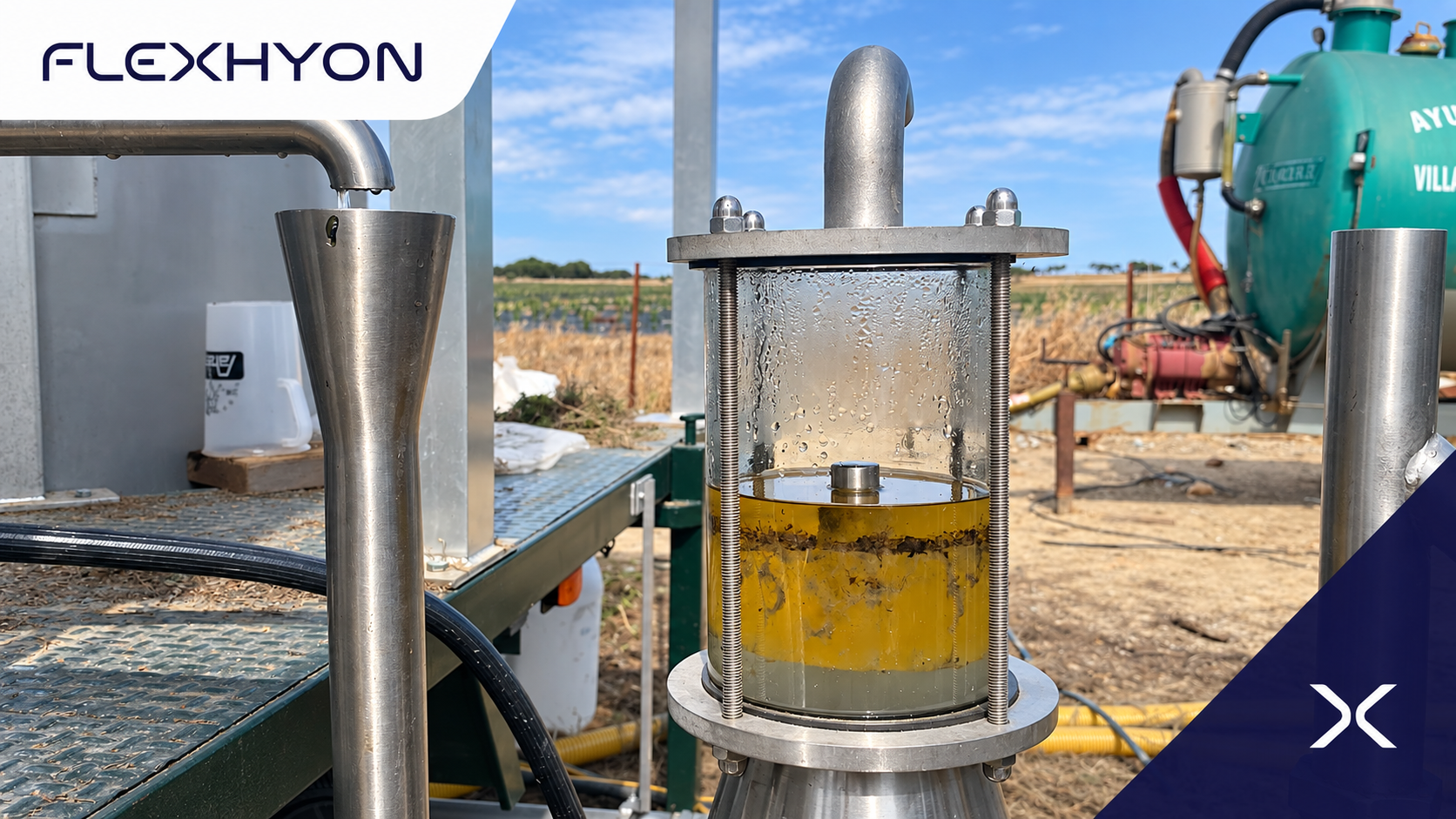
Aromatic plant processing is about more than producing essential oils. Plants such as rosemary and rockrose contain different valuable compounds that can be used in aromatherapy, cosmetics, herbal products and other bio-based applications.
The challenge is that these compounds do not always respond to processing in the same way. A method that works well for producing an essential oil may not be suitable for recovering other valuable substances from the same plant material.
FLEXHYON is exploring whether a combination of microwave and ultrasound technologies could create a more flexible way of processing aromatic plants.
For Pedro Pablo Pellín from EL JARPIL, this possibility was one of the reasons the company joined the project. EL JARPIL saw an opportunity not only to reduce processing time for essential oils, but also to investigate whether oils, extracts and other valuable plant compounds could be recovered through a more integrated process.
From one plant to more possibilities
EL JARPIL has worked with aromatic and medicinal plants since 2004. The company produces and commercialises essential oils and herbal products, but its expertise begins much earlier in the production chain.
One of its activities is identifying new botanical materials with potential commercial value and bringing selected wild species and chemotypes into cultivation.
This is a complex process.
A plant may contain interesting compounds, but producers also need to consider how it grows, whether it can be cultivated reliably and whether there is sufficient market demand for the final product.
Many EL JARPIL products are certified organic. This is particularly important in markets such as aromatherapy, where customers value traceability, information about the chemical composition of products and the absence of unwanted residues.
Today, the company mainly supplies raw plant material to businesses specialising in extracts. Through projects such as FLEXHYON, EL JARPIL is also interested in exploring new extraction possibilities.
This brings the project to an important question: could more value be obtained from the same plant material?
Rosemary and rockrose as a starting point

Aromatic plants contain different groups of valuable compounds.
Some plants are mainly processed for essential oils, while others can also provide compounds such as polyphenols or glycosides. However, obtaining these products can require different processing conditions.
Pedro points out that the temperatures used for conventional distillation can irreversibly affect some other active compounds present in the plant. As a result, producers may need to choose which type of product they want to obtain or use separate processes.
FLEXHYON is investigating whether combining microwave and ultrasound could offer another approach to biomass processing.
EL JARPIL has proposed rosemary (Rosmarinus officinalis L.) and rockrose (Cistus ladanifer L.) as the first plant materials to be tested. Both species are well known to the company and have already been used in previous research activities.
These species represent a starting point. Based on the first results, FLEXHYON may later investigate other aromatic plants containing valuable compounds such as terpenes, essential oils and other useful molecules.
One of the most interesting possibilities is the simultaneous extraction of different groups of valuable compounds from the same plant material. With conventional approaches, processors may sometimes need to choose which compounds they want to recover because the conditions used to obtain one product can negatively affect others.
FLEXHYON is exploring whether microwave and ultrasound technologies could help overcome this limitation and allow different valuable compounds to be recovered within a more integrated process.
For Pedro, this possibility could be particularly important.
“If we could obtain both groups of molecules simultaneously with the prototype to be developed in FLEXHYON, it would represent a substantial change in the possibilities for making use of, and reducing the cost of, the final products.”
The idea is not simply to produce the same product in a different machine. It is to explore whether plant material could be used more efficiently and provide producers with more options.
Why temperature and continuous processing matter
Processing conditions can have a major influence on both efficiency and the final product.
Pedro identifies several potential advantages of the combined use of microwave and ultrasound for processing these materials, including lower water and energy consumption, shorter processing times and the possibility of working at lower temperatures.
Lower-temperature processing can be especially relevant when valuable plant compounds are sensitive to heat.
Another important aspect is how the material moves through the system.
Conventional steam distillation is normally a batch process. Plant material is loaded into a vessel, processed, removed and replaced with a new batch.
Pedro explains that this repeated handling also increases labour requirements.
FLEXHYON is exploring a more continuous approach. In simple terms, instead of treating production as a series of separate batches, the aim is to investigate whether plant material can move through the process in a more continuous way.
If successful, this could reduce repeated loading and unloading operations and improve handling efficiency.
The FLEXHYON project is currently developing and testing its new eco-heating systems. Laboratory work is now being followed by the engineering, development and testing of prototypes that will later be demonstrated in industrial conditions.
When does a new process become competitive?
Better energy performance alone is not enough to make a new industrial technology successful.
For Pedro, one of the most important questions is processing capacity.
A system may use less energy, work quickly and produce good-quality results, but it must still be able to process sufficient quantities of raw material.
“Even with very good efficacy, speed and yield, if the throughput of plant material per unit of time is low, it will not be competitive with current methods.”
This makes scalability a key part of the FLEXHYON biomass case.
The project plans to develop a portable system capable of processing fresh aromatic plants. The planned system is expected to reach a distillation capacity of at least 20 kg of fresh aromatic plants per hour.
This target provides an important bridge between laboratory research and industrial application.
The technology must ultimately be assessed not only by asking whether it works, but also whether it can process useful quantities of material efficiently, reliably and at a competitive cost.
Testing FLEXHYON against conventional processing
To answer these questions, FLEXHYON will later move from controlled development to validation under representative conditions.
EL JARPIL will support this work together with CEDER-CIEMAT.
The partners plan to process the same plant materials at real locations using both the new FLEXHYON prototype and EL JARPIL’s existing mobile steam distillation equipment.
This will make it possible to compare the approaches under conditions that are much closer to everyday production.
The project will assess factors including energy efficiency, environmental performance, operating costs, flexibility and the quality of the resulting essential oils and extracts.
For Pedro, this comparison is essential because industrial value depends on several factors at the same time.
A new process must demonstrate good efficiency and product quality, but it must also offer sufficient capacity and practical advantages for the companies expected to use it.
Product quality is only part of the challenge
The final quality of oils and extracts will be another important part of the future assessment.
Pedro notes that the first laboratory results provide encouraging indications for extracts and other processed products. However, larger-scale validation is still needed before conclusions can be drawn about the performance of the final system.
Essential oils may present an additional challenge.
Pedro points out that some quality standards for essential oils are linked not only to the characteristics of the final product, but also to the method used to obtain it, particularly steam distillation.
This creates an interesting situation for new technologies.
A product obtained using a different process could potentially demonstrate very good chemical quality while still raising questions about how it should be classified within existing standards.
For FLEXHYON, this means that successful industrial innovation is not only about developing a working technology. Future solutions also need to fit within quality requirements, market expectations and existing production practices.
Getting more value from plant materials
For aromatic plant growers and processors, the potential value of the FLEXHYON approach lies in combining several improvements within one system.
A more integrated process could help reduce processing time, improve the use of plant material and create opportunities to recover different valuable compounds.
One of the key possibilities being explored is whether different groups of compounds could be extracted simultaneously, rather than requiring producers to choose between them or use separate processing routes.
Continuous operation could also simplify handling, while scalability will determine whether these advantages can be transferred from research to commercially useful production.
This is why the involvement of industrial partners such as EL JARPIL is important.
Their experience helps the project evaluate not only what is technically possible, but also what producers actually need from a future system.
The next stages of FLEXHYON will show how these ideas perform as the biomass prototype moves towards demonstration and on-site validation.
Stay updated on FLEXHYON
Follow FLEXHYON to learn how microwave, ultrasound and other fully electrified technologies are being developed for biomass processing, ceramics and feed production.